
Binary Tree Maximum Path Sum
Description
A path in a binary tree is a sequence of nodes where each pair of adjacent nodes in the sequence has an edge connecting them. A node can only appear in the sequence at most once. Note that the path does not need to pass through the root.
The path sum of a path is the sum of the node's values in the path.
Given the root of a binary tree, return the maximum path sum of any non-empty path.
Example 1:
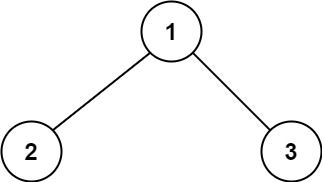
Input: root = [1,2,3]
Output: 6
Explanation: The optimal path is 2 -> 1 -> 3 with a path sum of 2 + 1 + 3 = 6.
Example 2:
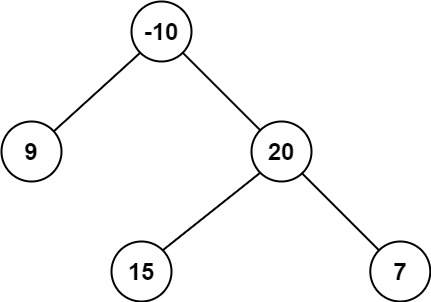
Input: root = [-10,9,20,null,null,15,7]
Output: 42
Explanation: The optimal path is 15 -> 20 -> 7 with a path sum of 15 + 20 + 7 = 42.
Constraints:
- The number of nodes in the tree is in the range
[1, 3 * 104]. -1000 <= Node.val <= 1000
Solution(javascript)
/**
 * Definition for a binary tree node.
 * function TreeNode(val, left, right) {
 *     this.val = (val===undefined ? 0 : val)
 *     this.left = (left===undefined ? null : left)
 *     this.right = (right===undefined ? null : right)
 * }
 */
/**
 * @param {TreeNode} root
 * @return {number}
 */
var maxPathSum = function(root) {
    let maxsum=-Infinity;

    function findmaxsum(node){
        if(node === null) return 0;
        const leftsum=findmaxsum(node.left);
        const rightsum=findmaxsum(node.right);

        maxsum=Math.max(maxsum, (node.val + leftsum + rightsum), node.val, node.val + Math.max(leftsum, rightsum));

        return Math.max(node.val, node.val+ Math.max(leftsum, rightsum));
    }

    findmaxsum(root)
    return maxsum;

};