
LeetCode

LeetCode

  • Problems
  • GitHub

›Problems

Problems

  • Two Sum
  • Add Two Numbers
  • Longest Substring Without Repeating Characters
  • Reverse Integer
  • String to Integer (atoi)
  • Palindrome Number
  • Longest Common Prefix
  • 3Sum
  • Remove Nth Node From End of List
  • Valid Parentheses
  • Merge Two Sorted Lists
  • Generate Parentheses
  • Merge k Sorted Lists
  • Remove Element
  • Next Permutation
  • Search in Rotated Sorted Array
  • Valid Sudoku
  • Group Anagrams
  • Maximum Subarray
  • Search a 2D Matrix
  • Binary Tree Level Order Traversal
  • Maximum Depth of Binary Tree
  • Balanced Binary Tree
  • Best Time to Buy and Sell Stock
  • Binary Tree Maximum Path Sum
  • Valid Palindrome
  • Word Ladder
  • Longest Consecutive Sequence
  • Palindrome Partitioning II
  • Linked List Cycle
  • Find Minimum in Rotated Sorted Array
  • Two Sum II - Input Array Is Sorted
  • Number of Islands
  • Reverse Linked List
  • Course Schedule II
  • Kth Largest Element in an Array
  • Contains Duplicate
  • Count Complete Tree Nodes
  • Invert Binary Tree
  • Valid Anagram
  • Find the Duplicate Number
  • Count of Smaller Numbers After Self
  • Longest Increasing Path in a Matrix
  • Top K Frequent Elements
  • Decode String
  • Longest Repeating Character Replacement
  • Max Consecutive Ones
  • Cracking the Safe
  • Binary Search
  • Design Circular Queue
  • Robot Room Cleaner
  • Peak Index in a Mountain Array
  • Fruit Into Baskets
  • Sort Array By Parity II
  • Unique Email Addresses
  • K Closest Points to Origin
  • Squares of a Sorted Array
  • Remove Vowels from a String
  • Optimize Water Distribution in a Village
  • Duplicate Zeros
  • Defanging an IP Address
  • Find Numbers with Even Number of Digits
  • Shuffle the Array
  • Running Sum of 1d Array
  • Number of Good Pairs
  • Richest Customer Wealth
  • Build Array from Permutation
  • Concatenation of Array
  • Final Value of Variable After Performing Operations
  • Maximum Number of Words Found in Sentences
  • Add Two Integers
  • Intersection of Two Arrays
  • Missing Number
  • Jewels and Stones
  • Find a Corresponding Node of a Binary Tree in a Clone of That Tree
  • Kids With the Greatest Number of Candies
  • Design Parking System
  • Minimum Sum of Four Digit Number After Splitting Digits
  • Root Equals Sum of Children
  • Plus One
  • Validate Binary Search Tree
  • Find Pivot Index
  • Largest Number At Least Twice of Others
  • Range Sum of BST
  • Subtract the Product and Sum of Digits of an Integer
  • How Many Numbers Are Smaller Than the Current Number

Optimize Water Distribution in a Village

Description

There are n houses in a village. We want to supply water for all the houses by building wells and laying pipes.

For each house i, we can either build a well inside it directly with cost wells[i - 1] (note the -1 due to 0-indexing), or pipe in water from another well to it. The costs to lay pipes between houses are given by the array pipes where each pipes[j] = [house1j, house2j, costj] represents the cost to connect house1j and house2j together using a pipe. Connections are bidirectional, and there could be multiple valid connections between the same two houses with different costs.

Return the minimum total cost to supply water to all houses.


Example 1:
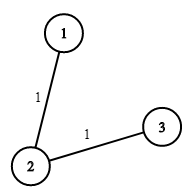
Input: n = 3, wells = [1,2,2], pipes = [[1,2,1],[2,3,1]]
Output: 3
Explanation: The image shows the costs of connecting houses using pipes.
The best strategy is to build a well in the first house with cost 1 and connect the other houses to it with cost 2 so the total cost is 3.

Example 2:

Input: n = 2, wells = [1,1], pipes = [[1,2,1],[1,2,2]]
Output: 2
Explanation: We can supply water with cost two using one of the three options:
Option 1:
  - Build a well inside house 1 with cost 1.
  - Build a well inside house 2 with cost 1.
The total cost will be 2.
Option 2:
  - Build a well inside house 1 with cost 1.
  - Connect house 2 with house 1 with cost 1.
The total cost will be 2.
Option 3:
  - Build a well inside house 2 with cost 1.
  - Connect house 1 with house 2 with cost 1.
The total cost will be 2.
Note that we can connect houses 1 and 2 with cost 1 or with cost 2 but we will always choose the cheapest option. 


Constraints:

  • 2 <= n <= 104
  • wells.length == n
  • 0 <= wells[i] <= 105
  • 1 <= pipes.length <= 104
  • pipes[j].length == 3
  • 1 <= house1j, house2j <= n
  • 0 <= costj <= 105
  • house1j != house2j

Solution(javascript)

/**
 * @param {number} n
 * @param {number[]} wells
 * @param {number[][]} pipes
 * @return {number}
 */
var minCostToSupplyWater = function(n, wells, pipes) {
    for(let i = 0; i < wells.length; i++) {
        pipes.push([0, i + 1, wells[i]])
    }
    pipes.sort((a, b) => a[2] - b[2])
    
    let res = 0, p = []
    for(let [u, v, cost] of pipes) {
        let pu = find(u), pv = find(v)
        if(pu !== pv) {
            p[pu] = pv
            res += cost
            if(--n === 0) return res
        }
    }
    
    function find(x) {
        if(p[x] === undefined) p[x] = x
        while(x !== p[x]) {
            p[x] = p[p[x]]
            x = p[x]
        }
        return x
    }
};
← Remove Vowels from a StringDuplicate Zeros →
  • Description
  • Solution(javascript)
Powered By LeetCode Site Generator